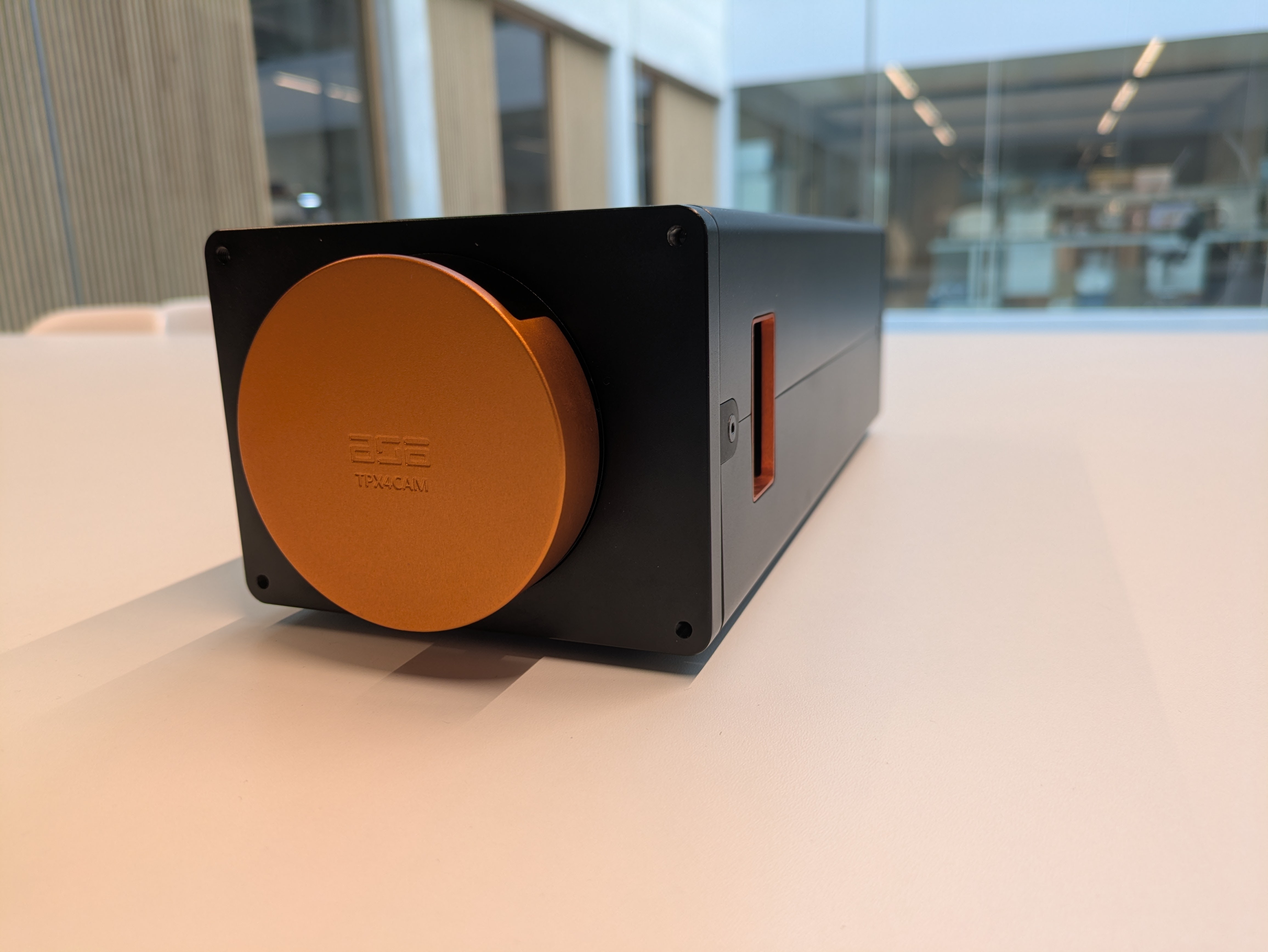
Hyperion T4 is an event-driven imaging detector built on CERN's Timepix4 chip. It records the position, arrival time and amplitude of every ion or electron that reaches the detector in a single acquisition, across all mass channels, with no gating and no limit on how many particles arrive at once.
Delay-line detectors offer excellent timing, but their multi-hit performance becomes limited when several particles arrive close together in time or position. Frame-based cameras capture the integrated image, but cannot record individual particles.
Timepix3 event-driven cameras provide both position and arrival time for every detected event, with a timestamp bin width of 1.56 ns. Hyperion T4 reduces that bin width to 195 ps while retaining event-driven, multi-hit imaging, substantially narrowing the gap between precise timing and particle-resolved detection.
For a Newton sphere spanning approximately 10 ns, a 4 ns resolution provides only two to three usable time slices. Hyperion T4's time resolution of 0.6–1.5 ns increases this to 7–17 slices, enabling more detailed reconstruction along the time-of-flight axis. Timepix3 already supported 3D electron imaging; Timepix4 provides 8× finer timestamp binning and approximately 3 to 7 times better measured system timing.
Every particle is localised and time-stamped independently. This means: no shared dead time and no reconstruction ambiguity when several particles land at once. Published work with the Timepix3 generation resolves hit pairs down to about 1 mm separation at up to 50 particles per shot; Timepix4's finer sampling improves on both.
True-coincidence measurements are normally kept below one ionisation event per cycle to suppress false coincidences. Covariance and cumulant methods remove this restriction when the detector can record multiple particles per shot, substantially increasing usable event rates and reducing the beamtime required for meaningful statistics.
512 × 448 pixels at 55 µm gives 6.94 cm² sensor area. Spend it on 1.75× finer sampling at your existing MCP plane, or on the same sampling across an MCP nearly twice the diameter. For microscope-mode mass spectrometry, that is 3.5 times the field of view per laser shot.
When detector timing dominates the TOF peak width, Hyperion T4 can provide up to approximately three times higher detector-limited mass resolving power at the same flight time. The overall improvement depends on the ion source, extraction fields and ion optics.
Hyperion T4 combines four TDC inputs with 195 ps timestamp bins and high-throughput Timepix4 readout. This allows each detected event to be correlated with individual source triggers in high-repetition-rate HHG, pump–probe and free-electron-laser experiments.
| Specification | Hyperion (Timepix3) | Hyperion T4 (Timepix4) |
|---|---|---|
| Pixel matrix | 256 × 256 | 512 × 448 |
| Pixel pitch | 55 µm | 55 µm |
| Active sensor area | 1.98 cm² | 6.94 cm² |
| Time bin width | 1.56 ns | 195 ps |
| Measured system time resolution | ≈ 2 ns | 0.6–1.5 ns |
| TDC inputs | 2 × 260 ps | 4 × 195 ps |
| Per-pixel dead time | ≈ 475 ns + ToT | ≈ 400 ns + ToT |
Detector performance is not defined by the readout chip alone. In an optical detector, timing depends on the phosphor screen, the microchannel plate, the optics and the camera. P47 phosphor screens with fast rise of approximately 5–7 ns are key to achieve precise timing, better than P46 or P43, while the MCP configuration influences count-rate capability and recovery time.
Timepix3 and Timepix4 pixels operate independently, so dead time is local rather than shared across the detector. In practice, rate performance depends on event density, cluster overlap, MCP recovery and readout bandwidth, not simply the dead time of an individual pixel.
Hyperion T4 is therefore specified as a complete, matched detection system, ensuring that each component supports the timing and count-rate requirements of the application.
If you are preparing a grant application, contact us for a formal quotation and a specification sheet you can attach to the proposal.
Prices exclude customs duties and taxes. Specifications are typical values and subject to change.
The Timepix3 generation of Hyperion and TPX3CAM is behind published work across the ion imaging community.
250 kHz three-dimensional ion imaging and MHz photoelectron imaging, shot by shot, at a free-electron laser.
Bromberger et al., J. Phys. B 55, 144001 (2022)Electron–ion coincidence imaging with every particle time-stamped independently, without gating.
Zhao et al., Rev. Sci. Instrum. 88, 113104 (2017)The first helium atoms binding to a single sodium ion at the surface of a helium nanodroplet, resolved on picosecond timescales with a TPX3CAM behind the imaging detector.
Albrechtsen et al., Nature 623, 319–323 (2023)A redesigned detector stack reaching an order of magnitude higher ion flux, read out with an ASI Hyperion.
Golibrzuch et al., Rev. Sci. Instrum. 96, 063304 (2025)Timepix4 performance is characterised in Hogenbirk et al., Intensified optical camera with Timepix4 readout, JINST 21, P02004 (2026).
Hyperion T4 is available now. Whether you need a quotation for a grant deadline, a compatibility assessment for an existing spectrometer, or an upgrade path from a Timepix3 system, we can help.